A growing number of businesses are introducing or strengthening policies or business ideas with an emphasis on sustainability. Following the triple-bottom-line (Elkington 1997), sustainable businesses combine ecological, economic and social aspects. In the last decades, this discussion on sustainable business innovation (Geissdoerfer et al. 2018) turned into various Circular Economy (CE) discourses (Calisto Friant et al. 2020, 2021), which examine value circles of materials, energy and biodiversity as well as their impacts for economy and society. CE businesses do not end with a consumer or landfill, but instead they allow consumers to put their goods or services, e.g. into a re-cycled value chain, thus allow for value-retention cycles. Three loops of different length are discussed in the literature (e.g. Reike et al. 2018): short (refuse, reduce, resell/re-use, repair), medium (refurbish, remanufacture, re-purpose), long loops (recycle, recover, re-mine)
In the light of this growing sustainability and circularity moves, we offer a programme to introduce circular thinking in combination with business model innovation (Osterwalder/Pigneur 2010, Bocken 2015).
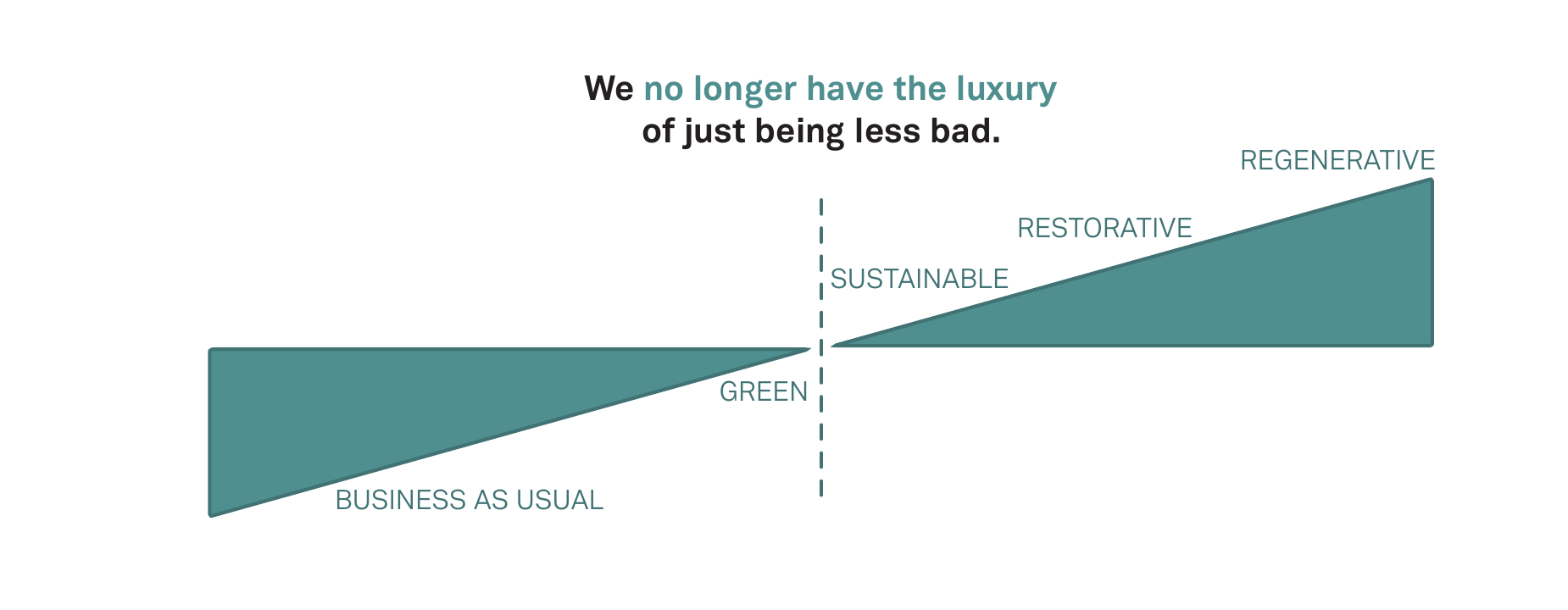
To assess how far a business has moved along this path, the bootcamp uses the RESTORE framework (Brown et al. 2018), which distinguishes five stages: conventional, green, sustainable, restorative and regenerative. Most companies participants encounter are still in the green-to-sustainable range, with clear room to move toward restorative and regenerative practice (Reed 2007) – the ultimate goal being not just to do less harm, but to actively regenerate the systems a business depends on.
The Circular Innovation Bootcamp
Circular Economy
Techniques that you will build on: Value Creation & Design Thinking; Value Proposition Design; Global to Local Challenge Exploration; Digital Transformation Design;
Business Model Design
Learn how to frame your global challenge and engage others in designing local solutions: Prototyping Creative Solutions: End User Testing & Customer Validation; Key Stakeholder Engagement; Pitching & Presentation Skills
International Exposure
Expand your networking capabilities in an international context: Learn co-creation skills to expand your own ideas and perspectives into bigger horizons and what is possible to achieve by collaborating with others
See also: References for the academic sources behind these concepts.